Get Marketing Insights First
Subscribe to receive actionable strategies, growth tips, and industry insights delivered straight to your inbox.
When deciding delta vs wye for equipment with single-phase controls, pick a Wye (star) winding with a real neutral wire on that side. Standard Delta fits pure three-phase loads needing no line-to-neutral tap. Check that line voltage divided by √3 matches your auxiliary circuit (400 V gives 230.9 V; 380 V gives 219.4 V; 660 V gives 381.1 V).
A three-phase dry-type transformer needs a Wye (star) secondary with a brought-out neutral conductor whenever your site runs single-phase line-to-neutral loads. Typical auxiliary loads include control panels, cabinet lights, and monitoring instruments. A standard Delta winding has only three line terminals and no natural neutral point, so it fits pure three-phase loads powered strictly between phases.
If you’re still deciding between single-phase and three-phase power, settle that choice first before selecting winding topology. If your site voltage doesn’t match your machine voltage yet, check our Step-Up vs. Step-Down Transformer Guide to lock in step-up or step-down ratings first. Once you know you need a three-phase unit, two checks settle Delta vs. Wye: neutral availability and the √3 voltage match.
A wye connection (star connection) joins one end of all three phase coils at a common center point. That center junction creates a potential fourth terminal for a neutral wire. A delta connection links the three coils end-to-end in a closed triangle, leaving only three line terminals and no neutral point. This fourth node in a Wye network is required whenever one phase powers single-phase AC equipment.
That structural gap matters immediately on site. Picture a mine ordering a three-wire Delta secondary for a crusher skid with 220 V PLC controls and lights. The main three-phase motor runs smoothly across the three phase lines. Yet the control cabinet has nowhere to land its neutral conductor, forcing a rush purchase of an extra control transformer.
Seeing “Wye” or “Y” on a preliminary quote still isn’t enough by itself. A usable neutral conductor means the center junction is physically wired out to a fourth terminal. A Wye-connected system can be built as a four-wire circuit with a neutral or as a three-wire circuit without one. When ordering a Delta-Wye transformer (Delta input feeding a Wye output), verify in writing that the secondary is four-wire with a brought-out neutral terminal.
Primary and secondary windings follow the same Wye or Delta connection rules in both single three-phase units and three-unit banks. See our Three-Phase Dry-Type Transformers page for available custom build scope before finalizing your winding spec.
Quote check before committing: Review both the secondary voltage and neutral wording on every preliminary quote for mixed loads. Divide your required three-phase line voltage by √3 to verify your auxiliary voltage match. Confirm the quote explicitly states a four-wire Wye secondary with neutral so you don’t buy an emergency control transformer later.
After confirming a four-wire Wye secondary, verify that its voltages actually fit your control panel. Line-to-line voltage is measured between any two phase wires. Line-to-neutral voltage (phase voltage) is measured between one phase wire and the neutral wire.
In a balanced Wye circuit, line-to-line voltage equals √3 times the line-to-neutral voltage and leads phase voltage by 30°. Balanced Wye keeps line current equal to phase current. In a balanced Delta circuit, line voltage equals phase voltage directly, so there is no center point to produce a lower single-phase voltage. Meanwhile, Delta line current equals √3 times the phase current inside each winding.
Dividing common industrial line voltages by √3 shows which Wye secondaries power standard single-phase controls directly:
High-Voltage Mining Supply vs. 220 V Control Panels: On 660 V mining systems, the Wye line-to-neutral output above sits far too high to feed 220 V controls directly. Plan a dedicated small control transformer or a separate winding rated for your control voltage.
Confusing line voltage with phase voltage on a dual-voltage nameplate can scrap an entire order.
Note whether your load needs a four-wire neutral and check line voltage divided by √3 before comparing the four full winding pairs.
For a three-wire supply feeding mixed loads, pick Delta-Wye; for pure three-phase loads needing no secondary neutral, pick Delta-Delta. Every three-phase transformer pairs a primary (input) winding with a secondary (output) winding, setting your neutral availability, harmonic behavior, and phase shift.
A three-wire vs four-wire supply means incoming power brings either three phase conductors alone or three phases plus a neutral. A Delta-Wye unit builds a four-wire output from a three-wire input, while a Delta-Delta transformer keeps both sides three-wire. A Wye-Wye transformer offers neutral points on both sides, whereas a Wye-Delta transformer pairs a Wye input with a three-wire Delta output. The matrix below summarizes these four topologies (full V-V bank conditions follow below):
| Decision Factor | Delta-Wye (Δ-Y) | Delta-Delta (Δ-Δ) | Wye-Wye (Y-Y) | Wye-Delta (Y-Δ) |
|---|---|---|---|---|
| Usable secondary neutral | Yes (from three-wire input) | No | Yes (N1, N2) | No |
| Mixed / unbalanced loads | Best fit for mixed four-wire loads | Pure three-phase only | Needs balancing & neutral path | Pure three-phase only |
| Third-harmonic path | Delta primary traps triplens | Closed Delta loops trap triplens | No Delta loop (see next section) | Delta secondary traps triplens |
| Phase shift | 30° shift (√3 terminal ratio) | No Δ-to-Y shift (check clock no.) | No Δ-to-Y shift (check clock no.) | 30° shift (√3 terminal ratio) |
| Single-unit fault (three-unit bank) | One failed unit stops bank | Three-unit bank only: V-V at reduced capacity | One failed unit stops bank | One failed unit stops bank |
| Winding turns & best fit | Low-power four-wire distribution | Full line V, 57.7% current; pure three-phase | 57.7% of Δ turns; balanced dual-N | HV step-down; lower coil V/insulation |
Three trade-offs behind that matrix change buying choices directly on site.
Delta-Wye for mixed loads: Even on a three-wire plant feed with no neutral, Delta-Wye creates secondary outputs across phase pairs as well as phase-to-neutral circuits. Its closed Delta primary circulates triplen harmonics internally. Plan around its 30° phase shift—and in three-unit banks, one failed unit disables the star group.
Delta-Delta and the Open-Delta boundary: When no secondary neutral is needed, Delta-Delta suits pure three-phase loads and circulates triplen harmonics. Because Delta coils carry full line voltage at 57.7% of line current, they require more turns and insulation than Wye coils. Keep construction types separate on fault backup. Three single-phase units can form a modular bank, whereas a single three-phase unit uses one core with less material, size, and weight.
Open-Delta (V-V) uses two single-phase units to feed a three-wire load after isolating one unit from a closed-delta bank. Any fault isolation, protection setting, and reconnection work must obey equipment limits, local utility standards, and an engineered switching plan. Do not expect Open-Delta backup as a default live-fault feature on a single three-legged core dry-type unit.
Wye-Wye and Wye-Delta trade-offs: Wye-Wye allows neutrals (N1 and N2) on both sides, while lacking a closed Delta loop for harmonic currents (covered next). Wye windings need 57.7% of Delta’s turns at the same line voltage. Same-type windings (Delta-Delta or Wye-Wye) also allow a direct 1:1 turns ratio without cross-connection shifts. For high-voltage step-down, Wye-Delta lowers per-coil voltage on the Wye primary, cutting turns and insulation cost. Under a 1:1 turns ratio, star-delta produces a √3:1 step-down line-voltage ratio. Its 30° shift and absence of a secondary neutral rule it out for four-wire panels.
When controls are tiny or voltages don’t divide by √3: Compare a Delta-Wye main unit against a pure three-phase main transformer paired with a small dedicated control transformer. List your main load and auxiliary control voltage separately so you don’t oversize a main winding for a few relays.
Shortlist the one or two winding pairs that match your supply wires and secondary neutral needs.
In general industrial practice, three connection mistakes cause major startup trouble. First, buyers overload an unstabilized Wye-Wye unit with uneven single-phase or electronic loads. Second, technicians disconnect a Wye neutral hoping to stop harmonic heating. Third, teams swap Delta and Wye on a replacement without checking the 30° phase shift. Catching these three limits early protects switchgear, controls, and drives.
An unbalanced load happens when single-phase lighting, heaters, or controls draw uneven current across the three phases. Under balanced loads, the three phase currents cancel so neutral current equals 0 A. When load impedances differ, a grounded neutral holds the star point at zero volts and carries the return current. Without that grounded neutral, the center star point drifts off zero—a neutral shift. Load phase voltages then turn unequal even when your incoming three-phase supply is completely balanced. One leg can surge high while another drops too low to keep contactors closed.
Non-linear loads like rectifiers and LED drivers add third-harmonic current and other odd multiples of three (triplen harmonics). Unlike normal phase currents, triplen harmonics add together in the neutral wire. In a four-wire Wye-Wye circuit feeding harmonic loads, excessive current builds in the neutral, yet each phase still receives nearly clean voltage.
Picture a site technician feeling a warm neutral wire on a Wye-Wye panel and disconnecting it. Circuit simulations show that removing the neutral wire backfires immediately. It creates a “hot” floating center point on the load Wye and injects triplen-harmonic voltage distortion across every phase. By contrast, a closed Delta winding confines triplen harmonic currents inside the Delta loop. If one source winding opens in a Y-Y system, two load phases drop in voltage and the third loses power completely. That open-winding risk is why Delta sources are preferred for winding reliability.
Panel layout tip: On a four-wire Wye secondary, divide single-phase lights, controls, and instruments evenly across Phases A, B, and C. Balancing auxiliary circuits keeps neutral return current low and stops one phase from overloading early.
Matching kVA and line voltages on a replacement quote does not make Delta-Wye interchangeable with Delta-Delta or Wye-Wye. Under a balanced three-phase supply, Delta-Wye or Wye-Delta shifts terminal voltage ratio by √3 relative to winding turns ratio. It also creates a 30° phase shift between Wye and Delta voltages.
That 30° shift blocks direct swaps whenever a replacement transformer connects to an existing tied bus or shares loads with another unit. Decoding full vector-group clock numbers belongs to a dedicated vector-group check, and matching units for parallel operation belongs to a separate parallel-running check. On a tied system, never cross-swap Δ-Δ or Y-Y with a 30° shifted Δ-Y or Y-Δ unit. Also, don’t assume a step-down transformer can be backfed to step voltage up without confirming backfeeding limits in the design first.
Supply wire count adds another replacement limit. Avoid specifying a Wye-Delta step-down unit on a four-wire utility feed unless the site design confirms how the primary neutral is handled. Grounding the primary neutral risks circulating currents and burnout during supply unbalance or phase loss, while floating it invites switching overvoltage transients. Check your incoming wire count against the site design before ordering a replacement.
Neutral grounding availability means the secondary winding offers a center point an electrician can bond to earth when required. Delta-star transformers in low-power distribution provide that fourth-wire neutral or earth connection directly on the Wye secondary. Designing specific earthing schemes (such as TN, TT, or IT layouts) is a separate site-earthing task outside this guide.
Even if your machine only uses three phase wires and pulls no neutral, check the drive manual before choosing Delta. Some servo amplifiers and spindle VFDs rely on ground-referenced EMI and surge components that struggle with corner-grounded or ungrounded Delta power. For those drives, consider a Delta-Wye transformer with a solidly grounded neutral. That grounded center point keeps phase-to-ground voltages symmetric even when no neutral wire reaches the machine. Check your equipment manual and local electrical code for symmetric voltage-to-ground rules.
Your site folder should capture the existing connection type, auxiliary load balance, and drive-grounding rules before you inspect the nameplate.
Before approving a purchase order or wiring a transformer, read the nameplate connection field directly on the plate. Never guess internal windings from exterior terminal letters alone. Pair that plate check with a complete enquiry sheet—supply wires, voltages, load power, neutral needs, and enclosure specs—so your first quotation comes back right.
A transformer’s vector group or connection line on the nameplate shows how the primary and secondary coils are wired. “D” or “Δ” marks Delta, and “Y” marks Wye (star). On Chinese-labeled industrial plates, translate the connection and voltage rows directly rather than guessing from the model code.
Two of our photographed KKSG mining general-type dry-type transformer nameplates show where those printed fields sit (original field names are in Chinese, translated here to show each line):
KKSG-10KVA, Rated capacity 10KVA, Input voltage 380V, Output voltage 380V 220V, Frequency 50-60HZ, and Connection Y / Y.KKSG-30KVA, Rated capacity 30KVA, Input voltage 660V, Output voltage 380V, Frequency 50-60HZ, and Connection Y / Y.Locate those same lines—input voltage, output voltage, rated capacity, frequency, and connection—on your own plate before ordering or replacing a unit.
Never rely on a terminal board N marking alone to judge internal windings. Two of our photographed shop samples show why exterior stamps fall short:
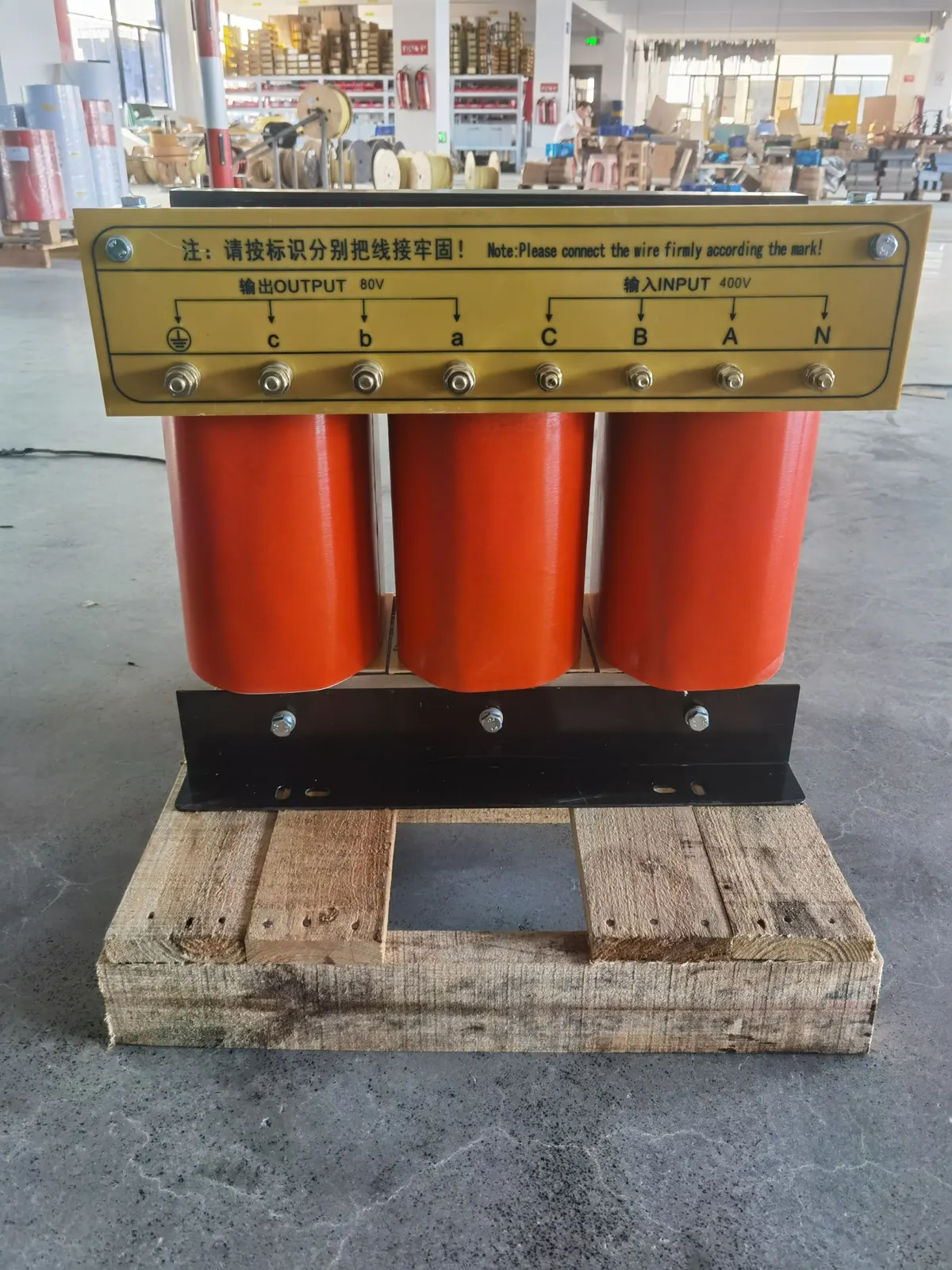
Why an Exterior “N” Label Never Proves Internal Windings: One cylindrical sample has a yellow board printed
INPUT VOLTAGE 380VandOUTPUT VOLTAGE N, 36V, 220V. Because no full nameplate, model number, or wiring diagram is shown, exterior letters alone never confirm phase count or internal windings. One cabinet sample shows three660Vinput markings and three400Voutput markings, plus anNmark at the end of the660Vlong board. Without a full nameplate or wiring diagram, you cannot tell which winding thatNterminal belongs to.
As standard industry practice, verify internal winding connections against the full nameplate and wiring diagram. For project acceptance, keep two international standard boundaries clear:
Preparing clear inputs up front speeds up quoting and prevents wrong-winding deliveries. Run through this Pre-Order Nameplate and Three-Phase Enquiry Checklist before requesting prices:
Leveling two quotes with a wide price gap: Send three direct technical questions before reporting to management. Ask each vendor in writing whether the unit uses two separated windings or a shared autotransformer coil. Also ask whether the primary is Delta or Wye, and whether the secondary brings out a full usable neutral matching the nameplate symbol. Those three answers catch cheaper bids that quietly drop winding separation or neutral capability.
At Zhejiang Hongmei Electrical Manufacturing Co., Ltd., we build custom three-phase dry-type transformers to your input voltage, output voltage, load power, and enclosure, size, and material specs. We handle core steps in house—coil winding, varnish impregnation, drying, assembly, wiring re-check, inspection, and outgoing factory inspection—alongside incoming inspection for purchased parts. Custom orders start from 1 unit with no sample fee and pack in wooden crates or cartons. Our reference production lead time is 7–15 days. We provide a 1-year warranty starting when you receive the unit, backed by remote video and online technical guidance. Review custom configurations on our Three-Phase Dry-Type Transformers page.
If we were in your shoes specifying or replacing a three-phase dry-type transformer this week, we’d run five quick site checks with your electrician before ordering. Starting with supply wires and auxiliary loads settles the Delta vs. Wye decision cleanly before prices enter the conversation.