Get Marketing Insights First
Subscribe to receive actionable strategies, growth tips, and industry insights delivered straight to your inbox.
When your transformer arrives on site—or when you’re reviewing a pre-shipment drawing—place the transformer nameplate beside your purchase order. Walk through five groups in order: kVA capacity, supply ratings, connections and impedance, thermal limits, and unit identity.
A transformer nameplate’s kVA rating shows the continuous apparent power your unit carries under steady rated conditions. Compare that kilovolt-ampere (kVA) figure directly against your calculated load in kVA. Checking both numbers on the same unit basis confirms capacity before you sign off.
Apparent power in kVA measures total electrical load. Equipment such as motors lists active shaft output in kilowatts (kW) instead. Converting a motor’s kW rating into kVA requires both the motor’s power factor and efficiency. When you need the exact math, see how to convert kVA to kW for a transformer load.
Once you confirm kVA, you’ll likely check full-load current for sizing cables and breakers. Because current depends on both voltage and phase layout, follow our walkthrough to convert kVA to single-phase or three-phase current.
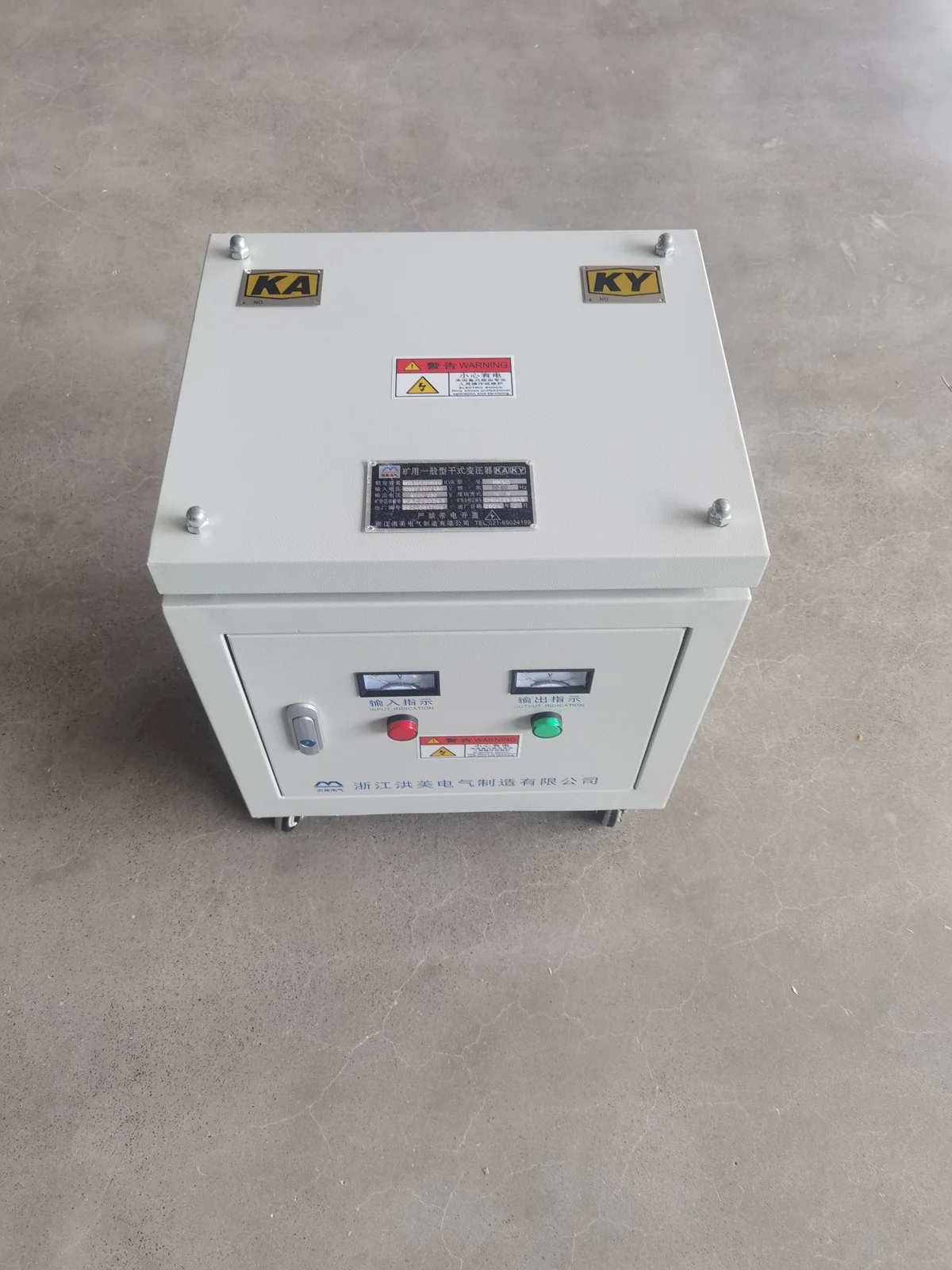
Picture standing beside a newly delivered crate in a mine yard with the purchase order in hand. Our photographed enclosure for KKSG mining dry-type transformers puts the nameplate on the top panel with a dedicated rated-capacity field. The stamped value in that wide photo is too soft to read clearly. Ask for a sharp close-up of your unit’s plate before shipment, and confirm capacity directly from that clear figure.
The kVA figure also comes with specific electrical conditions. International Electrotechnical Commission (IEC) standard IEC 60076-11:2018 gives a clear reference for how continuous ratings work. Your purchase order and unit documents set the governing standard for your own transformer. Its main scope covers dry-type power transformers up to 72.5 kV with at least one winding above 1.1 kV. It excludes single-phase units below 5 kVA, polyphase units below 15 kVA, and flameproof or mining units. Where no corresponding IEC standard exists for excluded or special transformers, that document may still apply in whole or in part.
Under that standard, the assigned rating assumes steady loading at rated primary voltage and rated frequency. Rated power also refers to continuous loading. Heavy motor starts or brief peak draws call for their own check alongside continuous capacity. Write down the kVA figure together with its rated voltage, frequency, and cooling notes on your receiving sheet.
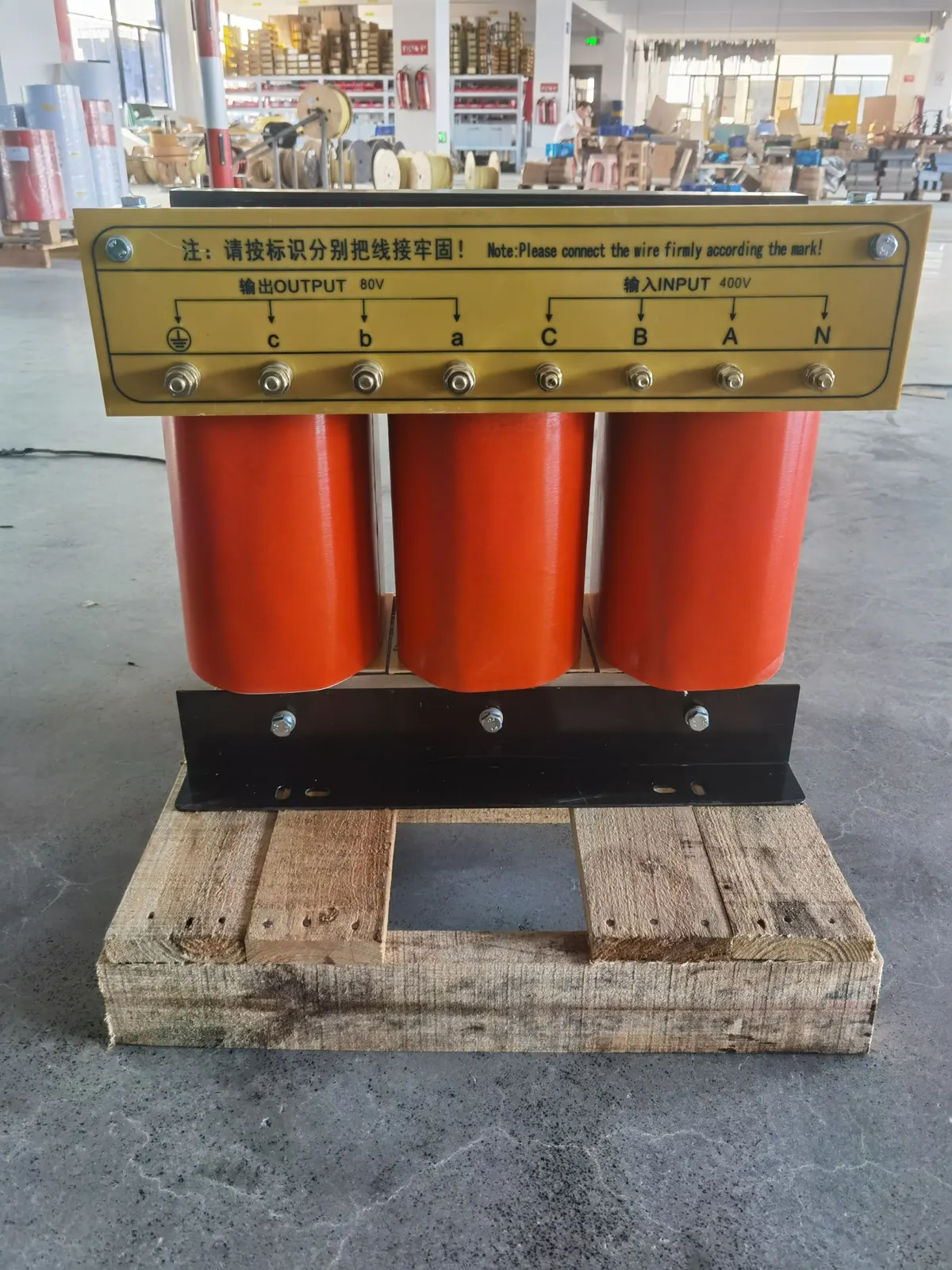
Matching transformer nameplate supply ratings means pairing input voltage with site power and output voltage with your equipment. You’ll also check conductor reference, phase, and frequency on their own. Our photographed nameplate places input voltage, output voltage, and frequency in separate fields so you can verify each side clearly.
Primary voltage—labeled as input voltage on our plate—is the incoming power feeding the transformer from your site network. Secondary voltage (output voltage) is the power leaving the transformer to run your machine or panel. When we prepare a quote, we ask for your input voltage, output voltage, and power. Keeping the site side and equipment side distinct helps your purchase order line up cleanly with the delivered plate.
Conductor reference matters just as much as the voltage number itself. Power system windings and loads connect either line-to-line (between two live lines) or line-to-neutral (between one live line and neutral). Those two wiring references produce different voltages. Two voltage numbers on a plate confirm those two figures alone, so verify phase count and wiring layout on the approved specification.
Phase tells you whether the unit runs on single-phase or three-phase power. Frequency, measured in hertz (Hz), shows how many cycles per second your alternating-current supply completes. Under the IEC standard introduced above, rated capacity assumes both rated primary voltage and rated supply frequency. A matching voltage still requires a matching frequency to hold that rating.
Use this four-column table to compare every supply entry against your order before sign-off:
| Nameplate field | Input given in your inquiry | What a mismatch means | What to verify before sign-off |
|---|---|---|---|
| Input voltage | Site supply voltage sent in your inquiry. | Delivered primary rating differs from your site power. | Confirm ordered site voltage and conductor pair on the approved drawing. |
| Output voltage | Equipment voltage sent in your inquiry. | Delivered secondary rating differs from your machine input. | Confirm the unit’s approved output rating and terminal drawing. |
| Rated capacity (kVA) | Load power requirement sent in your inquiry. | Plate kVA differs from the quoted load basis. | Confirm the continuous kVA rating matches your calculated load basis. |
| Phase | State single-phase or three-phase separately with equipment specs. | Voltage numbers alone leave phase compatibility unconfirmed. | Confirm single-phase or three-phase layout on the approved specification. |
| Frequency | State site and equipment frequency separately with specs. | Rating conditions differ from your site supply frequency. | Confirm the assigned rating applies at your site’s exact frequency. |
Enclosed units can also carry meters on the front door. Our photographed enclosure includes separate front-panel input and output indicators alongside the top nameplate. Those front-panel dials are input and output indicator meters, while the stamped nameplate holds the unit’s rating fields. Base your receiving sign-off on the stamped plate and approved drawing before anyone lands cables on the terminals.
Connection group and impedance voltage on a transformer nameplate explain how both windings are wired and how they behave under load. Connection group maps winding layout and phase alignment, while impedance voltage shows how the windings oppose alternating current. Our photographed plate carries a dedicated connection-method field for checking against your approved drawing.
Connection group describes the internal wiring layout on both sides of the transformer. Either the primary winding or the secondary winding can use a wye (star) or delta layout. Both sides together form the full connection description.
Those two layouts behave differently at the terminals. A wye connection is potentially a four-terminal layout with a possible neutral point, while a delta connection is inherently three-terminal. A wye marking tells you a star layout is used. Check the approved terminal drawing to confirm whether a usable neutral terminal is physically brought out for your wiring.
Matching voltage magnitudes still leaves phase alignment to verify. In an ideal delta-wye connection, voltages on the wye side are shifted in phase relative to the delta side. Under that same IEC standard, routine tests include measuring voltage ratio and checking phase displacement. Read what transformer checks and routine tests tell you to see how routine test records pair with your nameplate entry.
Impedance voltage (short-circuit impedance) represents the transformer’s series winding resistance and leakage reactance. Together, those two quantities govern how much output voltage drops as load increases.
During a short-circuit test, one winding is shorted while a test voltage is applied to the other winding until rated current flows. Keep that test voltage distinct from your normal site supply voltage.
When a nameplate lists impedance voltage as a percentage, that figure compares the short-circuit voltage at rated current against the rated voltage of that same winding. Treat that percentage as a winding voltage ratio, not an efficiency figure, and match the stamped value directly against your order specification.
Cooling method, enclosure setup, and insulation thermal class set the heat limits behind a dry-type transformer nameplate’s continuous kVA rating. Checking these thermal fields against your purchase order confirms that the stamped capacity holds up in your real installation space.
Cooling method shows how heat leaves the transformer core and windings during continuous operation. Under that same IEC standard, adding cooling fans lets the assigned rating differ from the rating without fans. When fans are supplied, the continuous rating without fans needs separate confirmation between buyer and supplier. Verify that your receiving record matches the exact cooling setup you ordered, whether natural air or fan-assisted.
Enclosure plans deserve the same attention early in procurement. When we prepare a quote, we ask whether your inquiry has enclosure, size, or material requirements.
Plan ahead if you buy a bare dry-type unit for a site-built cabinet. Under that same standard, a transformer and enclosure delivered separately—or enclosed later on site—need a combined thermal assessment and assigned rating. Flag any planned cabinet early so you verify the enclosed assembly’s confirmed rating alongside the bare-core plate.
Insulation thermal class designates how the electrical insulation system is evaluated and classified for heat endurance. That same standard points to IEC 60085 for electrical-insulation thermal evaluation and designation.
Match the insulation class marked on your transformer’s nameplate or confirmed datasheet directly to your purchase order. If a thermal entry is missing, you’ll want written confirmation before installation begins.
Unit identity lines on a transformer nameplate tie the physical hardware to the right paperwork. Confirm the manufacturer name and complete model against your purchase order first. Then log the unique factory serial number so multi-unit deliveries stay cleanly matched to their unit records.
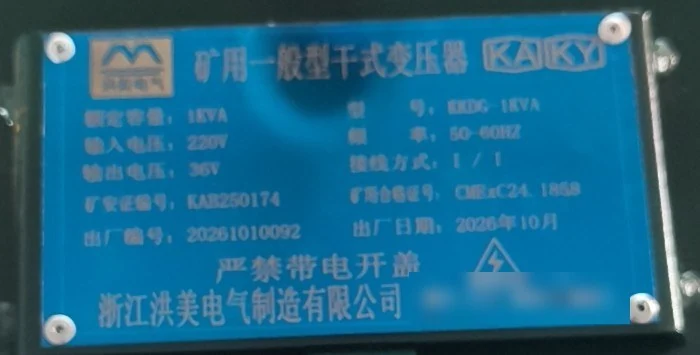
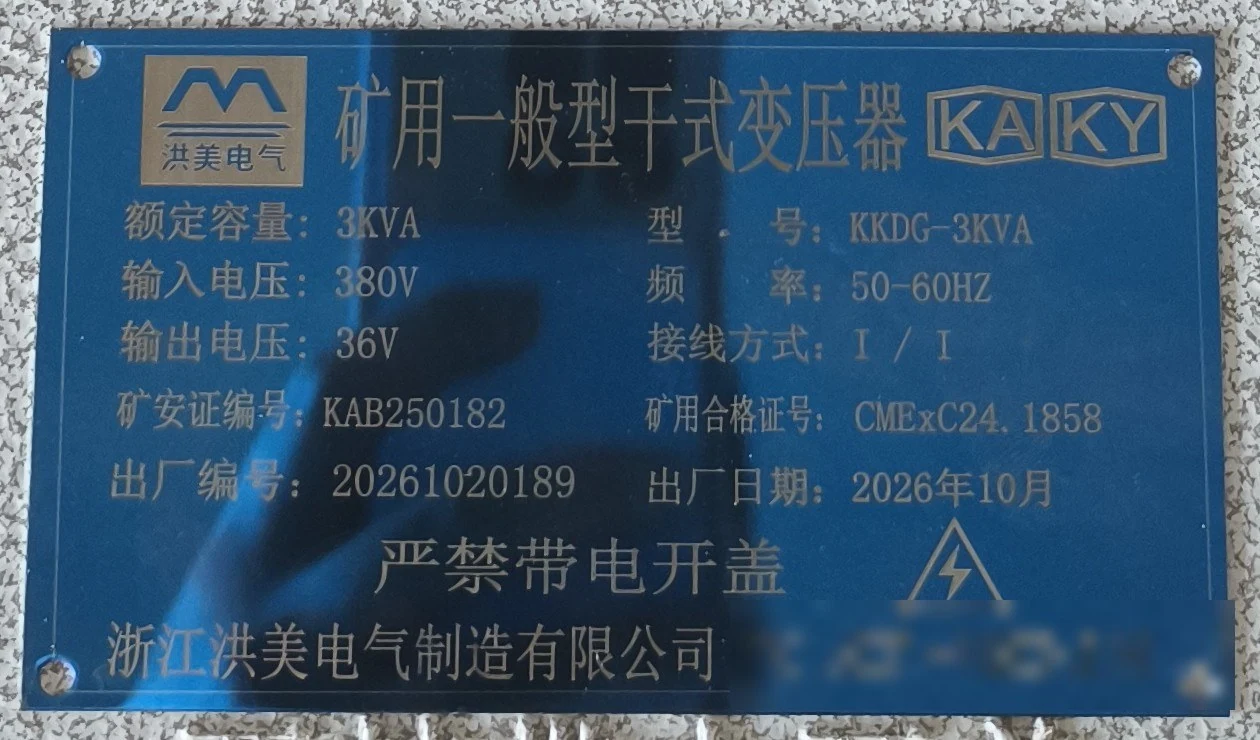
Start at the bottom and model lines of the plate. Our photographed plate identifies Zhejiang Hongmei Electrical Manufacturing Co., Ltd. as the manufacturer. Compare both the full manufacturer name and the complete model code on your delivered unit against your purchase order. A short series prefix leaves out the specific rating and build details you ordered.
Several reference numbers can appear on a nameplate or its datasheet, and each one answers a different question:
On our photographed KKSG plate, the mining-certificate number, factory serial number, and manufacturing date sit in separate fields. A stated standard field belongs to other common nameplates or order datasheets instead of that photographed plate. Record the factory serial number in its own column on your receiving log so every unit stays linked to its own paperwork.
Walking through a transformer nameplate in five clear steps turns a crowded metal plate into a calm receiving check. Follow capacity, supply, connections, thermal limits, and identity in order. You can run this same five-step check beside the crate or over a pre-shipment drawing.
When all five groups match your purchase order, site power, and equipment specs, you’re ready to file the records and sign off. If any field differs—or a pre-shipment photo looks blurred—pause acceptance and note four details. Record the full model, factory serial number, the differing field, and your order requirement so the mismatch gets settled before wiring starts.